A monopoly is not the same as legitimate greatness | by Cory Doctorow | June 2021
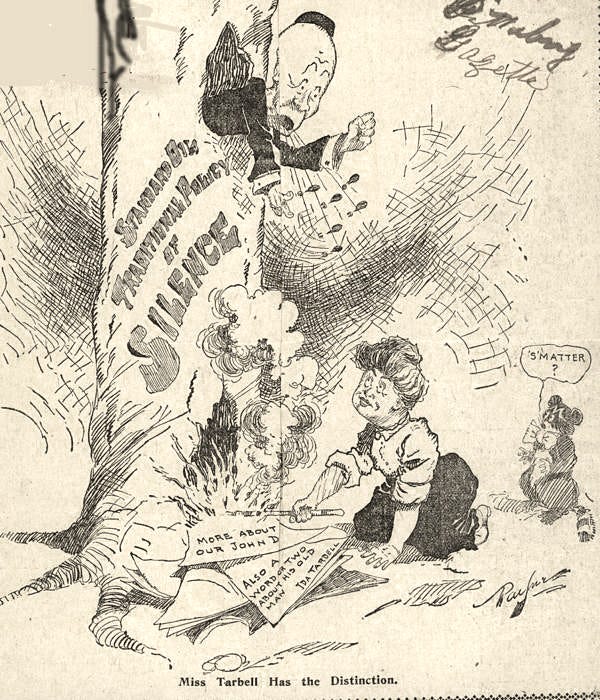
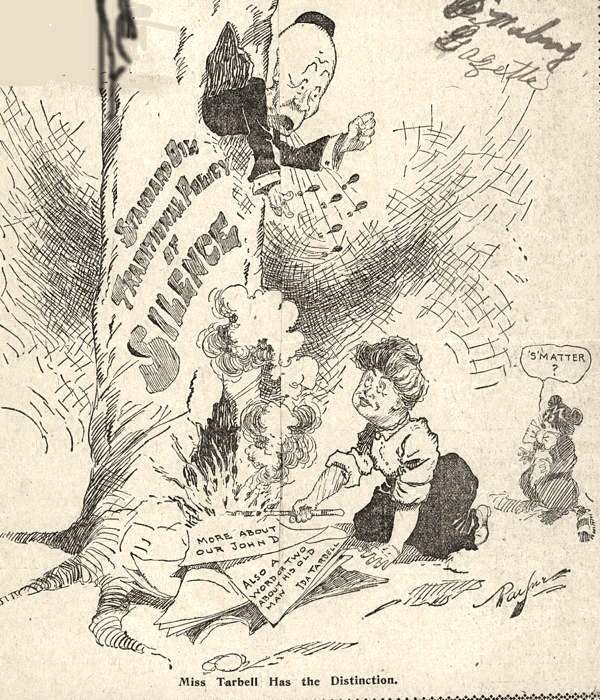
If you read a lot about antitrust, you are sure to stumble upon Ida Tarbell, the investigative journalist in the countryside whose masterful 1904 History of the Standard Oil Company (free ebook, free audiobook) brought down John D Rockefeller and his monopoly company Standard Oil, which was disbanded in 1911, split into seven companies, many of which are still with us or were until recent mergers (think: Exxon, Mobil, Esso , Chevron, Texaco and Amoco).
After having read several times aboyout Tarbell’s remarkable book, I decided to read it for myself. I had just finished a little too long Amy Klobuchar Antitrust (do yourself a favor and skip it, trying either Zephyr Teachout’s Break them or that of David Dayen Monopolized for a more disciplined and invigorating read, but if you see a copy in a bookstore browse their excellent selection of editorial cartoons from the trustbuster era), and I decided it was high time for me to read Tarbell .
It’s a fantastic book. Tarbell was a playful writer who had a knack for understatement as she untangles the wiles of Rockefeller and his cronies, which makes her findings all the more devastating. Tarbell was a self-taught writer – she came from a political family and grew up watching her father and friends in the Pennsylvania oil fields get crushed by Rockefeller’s dirty tricks – and she had a knack for speaking and speaking. organization. She toured the country with her book, denouncing the monopoly and creating momentum for a political attack on the world’s richest and most powerful man and his cronies.
Tarbell’s work has real applicability today. His account of Rockefeller’s tactics to corner the world’s energy supply has endless parallels to today’s tech barons. Equally important is the context of his work: Tarbell was self-taught and made no claim to objectivity. She was an activist and activist, independent and unlicensed (as she belonged to professional organizations, these are organizations that she herself helped found).
Remember, the next time someone tells you that the answer to political disinformation is to allow journalists, demand a absurd objectivity among them, and oblige them to adhere to a professional code of conduct administered by the large media companies which are accustomed to relying on the powerful.
I was particularly struck by this passage from Tarbell History (emphasis mine):
Something in addition to the illegal benefits went into the creation of the Standard Oil Trust. If he had only possessed the qualities that the general public has always attributed to him, his overthrow would have preceded him. But this enormous mass, blackened by commercial sin, has always been strong in all great commercial qualities – in energy, intelligence, fearlessness. He has always been rich in youth as in greed, in brains as in lack of scruples. If he has played his big game with contemptuous indifference to fair play, and with fine legal points of view, he has played it with consummate skill, daring and dexterity. The silent, patient and omniscient man who led him in his transport raids did not lead him with less success in what can be called his rightful work. No one has appreciated better than he those qualities which alone ensure the stability and permanent growth of commercial enterprises. He insisted on these qualities, and it is because of this insistence that the Standard Oil Trust has always been something other than a beautiful piece of brigandage, with the plight of brigandage before it, that it has been a thing with life and the future.
If we try to analyze what we can call legitimate greatness of the creation of Mr. Rockefeller in distinction of his illegitimate greatness, he will find at the base the fact that it is as perfectly centralized as the Catholic Church or the Napoleonic government. (Vol 2, Chapter 17)
This is Tarbell at his best, killing Rockefeller with kindness. After hundreds of pages detailing all kinds of dirty tricks – lying to a German oil buyer to leave the company rather than buy competing oil; sending railroad goons to beat up workers trying to connect a rival pipeline; corrupt state legislators; lie in court, and worse – Tarbell concedes that Rockefeller is really good to be twisted, and that this is part of its overall competence in all things.
Here, Tarbell strikes at the heart of the monopoly problem: that a competent dictator is not the same as a benevolent dictator. Tarbell spends several pages after this passage explaining the incredible progress Rockefeller has made in the industry: for example, he has kept meticulous statistics on the efficiency of Standard Oil Trust refiners and whether a refiner starts taking oil. ahead of the others, he send committees from all the other refineries to learn how to replicate their success.
This type of cooperativism is at the origin of the calls of certain leftists to nationalize (rather than break) monopolies. Books like Mason’s Postcapitalism and Phillips and Rozworski Walmart People’s Republic take up Marx’s vision for a society industrialized by capitalism and democratized by socialism.
These companies are often remarkably efficient and already operate as planned economies (when you go to work at Amazon, a marketplace doesn’t decide where you sit and what work you do – rather, Party Secretary Bezos delegates a commissioner to deploy your work. in the service of the execution of a five-year plan). Why not just put them in public ownership?
Tarbell’s meticulous research and brilliant storytelling complicates this proposition. Person reading it History would conclude that the Rockefeller empire was the best oil company – rather it was the best oil company for the likes of John D Rockefeller.
Sometimes “Best Rockefeller Oil Company” was synonymous with “Best Oil Company”, but often it wasn’t. Rockefeller used to buy and shut down refineries that were too far from headends or pipelines to operate profitably (an economically and socially sound prospect), but then abandoned them to become toxic plagues on communities. destroyed (something that was detrimental to the public interest, but benefited Rockefeller).
The monopolist’s ability to be “illegitimately big” means that it’s hard to tell when a big business has grown because it has found a better way of doing things, and when it has grown because it has grown. ‘came out cheating.
I have an old friend who was an executive in one of the two major consumer packaged goods monopolies in Canada. The Unilver-Procter & Gamble duopoly plays exceptionally badly with each other, and even worse with small businesses trying to enter the market.
The stories of my friends have always marked me as examples of how monopolists are able to ensure that their most profitable products dominate – rather than the best. For example, periodically, grocery stores would all have mouthpieces filled with Kraft peanut butter jars in the shape of a teddy bear:
These bear jars were in great demand, as they were exceptionally inexpensive (cheaper in volume than cylindrical jars) and they made large decorative jars, highly prized as piggy banks.
Considering all of this, it’s weird that they haven’t always been for sale. My friend explained, however: Kraft would only offer them for sale when they heard that Procter & Gamble were planning to try to launch their American peanut butter super-seller Jif in Canada. Kraft would flood the market with these cheap and highly desirable jars ahead of Jif’s launch, ensuring that every peanut butter customer would already have a six-month supply of Kraft in plush jars when Jif hits shelves. Even though Canadian grocers were curious about Jif, they already had all the peanut butter they needed.
This type of predatory pricing is rampant in grocery sales. My friend described how workers at P&G had to take a certain route when they went to downtown Toronto to see if the detergent piles at Unilever factories were working; this, combined with other signals (such as responses to pretextual calls for tenders to packaging companies regarding the availability of cardstock and production lines) has enabled P & G’s competitive intelligence unit to come together. get an idea of when Unilever should launch a new detergent. P&G will beat them in the market with below-cost cans of Tide that would meet all the detergent market demand over the next six months, throttling the new detergent in the cradle.
Kraft and Tide peanut butter aren’t necessarily the best products, only the ones that have been most successfully promoted through “illegitimate greatness.” We don’t know if people would prefer competing products because competing products have been gutted from the market.
Today, big business boosters and skeptics are likely to praise tech monopolies for their rightful greatness: Facebook’s social interaction leadership, Google search, Amazon logistics, Apple conservation (the Business boosters say this greatness is proof that monopolists deserve their place; skeptics say this greatness militates to turn these companies into public services).
But it is impossible to know where legitimate greatness ends and illegitimate greatness begins. The competence of the leaders of our technological monopolies is not in question, but their benevolence is. There have been times when Rockefeller has done the world a service, finding new and efficient ways to make energy cheap and reliable. There have been times when Rockefeller has hurt everything but his group of shareholders, by polluting, corrupting and impoverishing.
As for me, I think the lesson of the Standard Oil shattering and Tarbell’s limpid analysis is that we need to break through the inexplicable tyranny of the boardroom, not just because it is a prerequisite for scrutiny. democracy of our lives, society and the planet. but because the illegitimate greatness of billionaires makes it impossible to know which of their accomplishments are legitimately great.
And as for Tarbell, you really should read it! Its founding books are free, in the public domain, and there is even free audiobooks. Tarbell broke all kinds of barriers, obtaining a university education in science at a time when women were excluded from science.
She was praised in her time for her ability to make complex technical problems both accessible and urgent to a wide audience. It shines over a century later – and provides a methodological example for the rest of us.